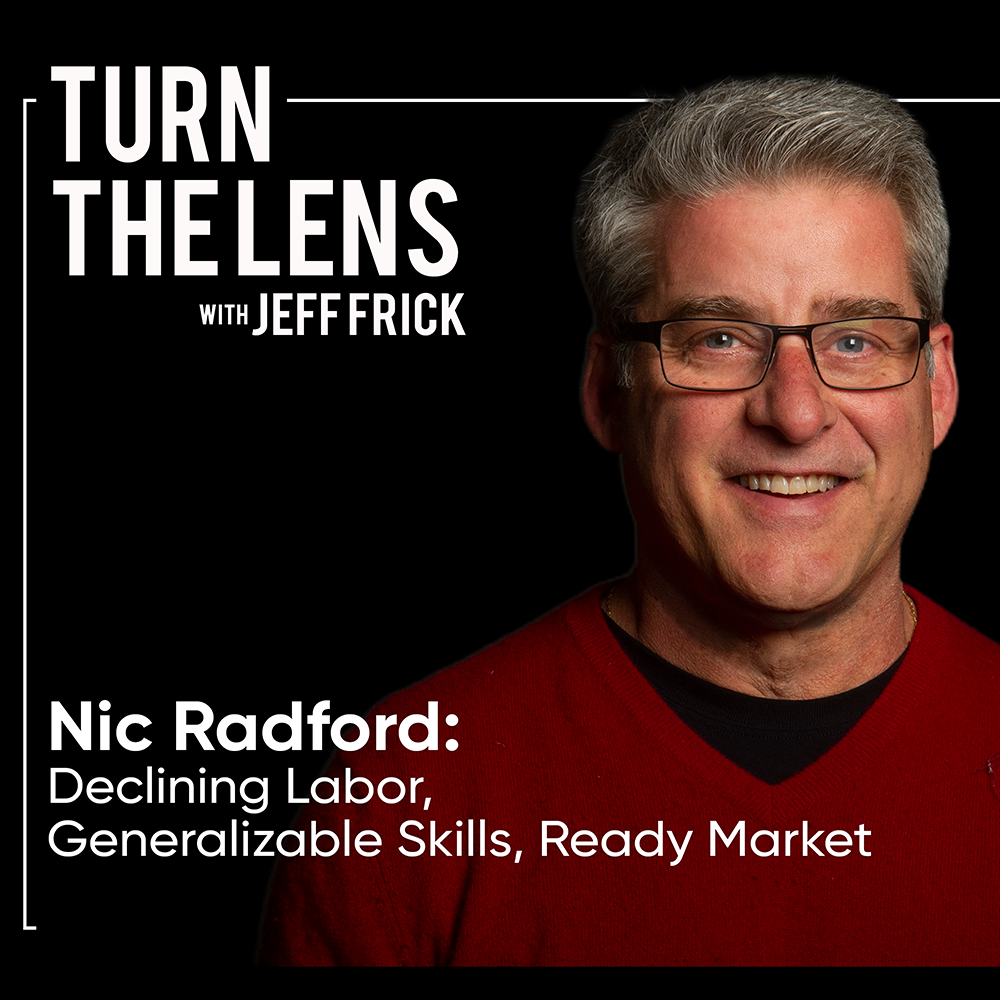
Nic Radford: Declining Labor, Generalizable Skills, Ready Market | Turn the Lens Ep47
"Robots are not hard to build. They're hard to make useful." Nic Radford, CEO of Persona AI
Or listen on:


Nic Radford has spent his career in extreme environments, NASA space robotics, deep ocean exploration, and now commercial shipbuilding automation. As CEO of Persona AI, he's tackling what he calls the "Fourth D" of robotics: declining labor supply in well-compensated skilled trades.
In this conversation from Humanoids Summit 2025, Nic explains why he chose welding in shipbuilding as Persona's entry point, how recent AI breakthroughs finally make humanoids commercially viable, and why the real barriers to adoption aren't technical, they're insurance, liability, and regulatory frameworks.
We discuss his systematic market selection process, the difference between generalizable skills and general-purpose robots, why he made ethics his first advisory board position, and what the 14-year Waymo timeline tells us about realistic expectations for humanoid deployment.
This interview is co-released by Turn the Lens and Humanoids Summit. Humanoids Summit is organized and hosted by ALM Ventures.
Recorded at the Humanoids Summit SV 2025, Computer History Museum, Mountain View, California.
Title: Nic Radford: Declining Labor, Generalizable Skills, Ready Market | Turn the Lens with Jeff Frick
Recorded: December 11, 2024
Location: Computer History Museum, Mountain View, California
Event: Humanoids Summit 2025 (Silicon Valley)
Duration: 18 minutes
Episode Number: 47
Collaboration: This interview is co-released by Turn the Lens and Humanoids Summit. Humanoids Summit is organized and hosted by ALM Ventures.
Current Role: Co-founder & CEO, Persona AI
LinkedIn: https://www.linkedin.com/in/nicolaus-radford/
Company: https://www.persona-ai.com
Career Highlights:
Notable Projects & Expertise:
Co-founder:
Traditional 3Ds:
Nic Radford's Fourth D: 4. Declining Labor Supply - Industries experiencing workforce shortages
Critical Refinement: Not just declining labor, but the intersection of:
Market Selection Result: Shipbuilding industry, welding as initial skill focus
Welding as Generalizable Skill:
Business Implication: Faster path to commercial viability than waiting for truly general-purpose humanoids
Initial Skill Focus: Welding
Why Welding:
Adjacent Applications:
Potential Expansion Industries:
AI & Machine Learning:
Control Systems:
Integration:
Quote from Interview: "Couple in the latest advancements in AI to really capable machines was starting to change the conversation in robotics"
Strategy: Partner with customer from inception
Contrast with Previous Ventures:
Market Timing:
Quote from Interview: "And the financiers are there, right... We'd never really have had that kind of outside of government contracting, government funding, government grants for research."
Advisory Board Structure:
Ethical Considerations:
Core Challenge: "Accidents at the hands of a machine"
Autonomous Vehicle Parallels:
Fatality Statistics (from interview):
Liability Questions:
Quote from Interview: "Regulatory and insurance has really been, they don't really know what to do with that."
Requirements for Commercial Deployment:
Current State:
Optimistic Timeline Perspective:
Quote from Interview: "I'm confident we're going to figure it out because as you see Waymo's driving around here, we're getting there."
Growth Trajectory:
Organizers:
Venue:
Industry Characterization:
Google/Waymo Timeline:
Robotics Deployment Timeline Implications:
Industry Strategy:
Safety & Human Interaction:
Applications:
AI Integration:
Safety & Ethics:
Compensation & Market Size:
Autonomous Systems:
Robotics-Specific:
Robotics-Specific Ethics:
"Robots are not hard to build. They're hard to make useful."
— Nic Radford
"I am tired, man. I am so tired. But I couldn't stay away from it."
— Nic Radford
"And the financiers are there, right. We'd never really have had that kind of outside of government contracting."
— Nic Radford
"Regulatory and insurance has really been, they don't really know what to do with that."
— Nic Radford (on accidents "at the hands of a machine")
"This industry is not going to transition on mass, writ large, as fast as people think. I still think faster than people think because I don't think people can grok exponential curves."
— Nic Radford
Humanoid Robot: Robot with human-like form factor (head, torso, two arms, two legs) designed to operate in human environments
Generalizable Skill: Capability that transfers across multiple tasks (e.g., tool manipulation applicable to welding, painting, grinding)
Cross-Embodiment Learning: AI/ML technique allowing models trained on one robot platform to transfer to different robot hardware
Vision-Language-Action (VLA) Models: AI models that process visual input and language instructions to generate robot actions
Foundation Models: Large-scale pre-trained AI models that can be adapted to multiple downstream tasks
Teleoperation: Human remote control of robots, often used for training data collection
Fourth D: Nic Radford's addition to robotics application framework - Declining (well-compensated) labor supply
SEO & Discovery Tags
Primary Keywords: Humanoid robotics, skilled trades automation, welding robots, labor shortage solutions, generalizable robotics skills, robotics commercialization, AI robotics integration
Industry Terms: Shipbuilding automation, manufacturing robotics, heavy industry robotics, skilled labor replacement, workforce augmentation
People: Nic Radford, Nicolaus Radford, Jerry Pratt, Persona AI, Jeff Frick
Topics: Robotics ethics, autonomous system insurance, robot liability, AI governance, foundation models for robotics
Geographic: Silicon Valley robotics, Mountain View tech, Computer History Museum
Events: Humanoids Summit 2025, robotics conferences, ALM Ventures events
Contact & Social
Guest:
Nic Radford: https://www.linkedin.com/in/nicolaus-radford/
Host:
Jeff Frick: https://www.linkedin.com/in/jeffreydfrick
Event:
Humanoids Summit: https://humanoidssummit.com/
Intro
Jeff Frick:
Hey, welcome back everybody. Jeff Frick here, coming to you from the Baylands. So we’re excited to release another one of the ten interviews we did at Humanoids Summit. His name is Nic Radford. He is the CEO of Persona AI.
Nic has done a number of robotics projects. He worked at NASA for a long time, working within the harsh environment of space and bringing robotics to space. Then he decided, hmm, what other environment could be as harsh as space? So then he went into robotics in deep oceans.
Now he’s taking a completely new approach with Persona AI. And what he said in his keynote that really struck me: robots are not hard to build, they’re hard to make useful.
This time around, what he decided to do commercially is try to identify where the market opportunity was the richest for him to make a move. And so he looked at the traditional three Ds of robotics, dirty, dull, and dangerous. But he looked at the fourth D, which is declining labor supply.
And what are the industries that have a declining labor supply, but not only a declining labor supply, but that labor supply is well-paid? And where this adventure took him to were the trades and heavy industries. Because the fourth piece of the puzzle is how open are the companies in the industry to try new things, to adopt new things.
And so he landed in shipbuilding, and he landed on this skill of welding, which is pretty interesting. Because welding, as he mentioned, it’s not a generalized robot, but it’s a generalized skill, in that it’s doing something with a tool around some rules. And there’s some real potential there to extend that to painting, grinding, other types of skilled labor activities where there’s just not enough people to fill the demand.
We also talked a little bit about business considerations, because you’ve got to think about things like insurance and liability, and those are boxes that have to get checked before you can really get to broad commercial adoption. We’re seeing success there with Waymo, because you know who’s responsible if there’s an accident. Is it in the software? Is it in the operation? Is it in the hardware? Over time, these challenges will continue to get sorted out.
Humanoids Summit is put on by ALM Ventures and Modar Alaoui and Jesica Chavez. Without further ado, my conversation with Nic Radford.
Cold Open:
Ready?
Yeah.
Alright, in five, four, three…
Main Interview Begins
Jeff Frick:
Hey, welcome back everybody. Jeff Frick here, coming to you from the Computer History Museum in Mountain View, California. This is the second time they’ve had the Humanoids Summit here. We were here a year ago, and it was not quite the same. I think the numbers have tripled. They were in London in the summer, and they just announced they’re going to be in Japan next summer. So the momentum behind this is pretty crazy. Andra Keay last year said it was a Cambrian explosion moment, but I think she might have been a little bit early on that, because it’s going bananas now. And we’re excited to have our next guest, just coming off his keynote. He’s Nic Radford, the co-founder and CEO of Persona. Nic, great to see you.
Nic Radford:
Jeff, thank you so much for being here.
Jeff Frick:
Love it.
Nic Radford:
Such energy in the convention center and historic area. I think it’s really fitting. I can’t wait till we’re in, you know, the successor of you is going to be doing this in the Humanoid History Museum in 25 years. Maybe 50
Jeff Frick:
Maybe 50. I don’t know. Well, you know, it’s funny, I’ve been talking a lot about the Waymos, because the Waymos are the autonomous robot that everybody can see. And they’ve got some of the original ones here in the Computer History Museum.
Nic Radford:
Oh yeah. Wow.
Jeff Frick:
And the pod where they trained was not far away either. So I always ask people, it’s been 14 years since they launched the Google self-driving project to Waymo opening it up to general distribution. So is that a short time or a long time? And does it even matter today if I need to get to the airport?
Nic Radford:
Yeah, true. And it goes even further back than that. If you go back to the DARPA Grand Challenge, which was really, you know, in the fatherhood of those programs, I think it was 2004, 2005, led to the Urban Challenge 2006 and 2007. And if you compare the results of that versus the Waymos that are driving around here and San Francisco, I think it’s just fascinating.
But it’s also really important to think about how long industries take to transition. You know, it took us 25 years to go from the horse and buggy to the automobile. And so now going from the automobile to the autonomous automobile, we’re kind of on a 15- to 20-year journey right now.
Jeff Frick:
Yeah, yeah. Which to me is short. That’s like nothing. I mean, you put it in functions of your college, or four-year things, it’s really not that long. But one of the big factors, and you talk about it, is all of these things that are lining up. All of them are kind of hitting these critical stages of advancement along the whole laundry list of technologies. It’s the coming together of these that are enabling these kind of mind-bending capabilities.
Nic Radford:
There’s been multiple tipping points, and I think technology is absolutely part of it. If you look at where compute was five, ten years ago, where the cost of things were at, technology tipping points have been crucial. Vision processing, vision is literally a solved problem. I mean, it’s pretty close, right? And those are some key enabling components to what’s allowing us in the humanoid industry to start to put those building blocks together and make useful things that do useful tasks in the world that somebody might pay for. There’s a multidimensional tipping point between the technology, the economics, and also social acceptance.
Jeff Frick:
Right. And training. So one of the things that was really fascinating to me last year was this LLM and these foundational models kind of changing the training paradigm so significantly. Instead of, like in an industrial robot where you train it to pick up that car panel and stick it in that place for the welding robot, now they’re learning. You’re having this generalized capability to not only pick up this glass, but pick up this phone and pick up this pen, a really different way to train them.
Nic Radford:
Yeah, and I would almost say a different way to program them. So again, I keep dating myself. I’m like, remember five and ten years ago? And half the kids here are like, no, I don’t remember that.
But you know, we used to program the machines, right? Very logically, state-machine driven. Then that kind of morphed into behavior trees that had a little bit more robustness to uncertainty, fail, retry, stuff. Now, as you mentioned, we’re literally teaching the machines, and there’s some good and bad about that, because what comes out, you know, you train these policies and you deploy them to the robot. And the robot does something and everybody stares at it. And they’re like, “Wonder why it did that?” We’re like, “I don’t know, let’s try to get some introspective analysis going. We’re not really sure why it did that.”
Jeff Frick:
You can’t check the code, right? You don’t get to see that line.
Nic Radford:
Yeah. So people are building out tools to try to understand why the robot is performing things that it’s doing. But yeah, it’s distinctly different. I mean, it used to take you a legion of programmers six months to program the robot to do something, and it was fragile. It didn’t work well to uncertainty or the dynamics of the environment.
But the way that we are teaching these machines, we are training large models with tons of inputs that then export sort of this policy to the robot. And it turns out that’s pretty robust, that’s pretty robust to a lot of external, external factors.
Jeff Frick:
Yeah. One of the key changes, too, has been kind of this move towards humanoids and the general purpose from what has been the dominant, which is not only industrial, but even in commercial, specific purpose-built robots, whether it’s a Roomba, which we all know, or now we’re seeing lots of commercial lawn mowers, I think is kind of the next big run-around little robot.
A humanoid’s very different. And you spent time at NASA, and NASA was here last time, and they kind of… it’s kind of a breakthrough moment. You want a humanoid because it can interact with things designed to interact with people, because it’s got the same form factor, in theory. Talk about the changes between general purpose and humanoid and specific purpose and even, you know, kind of built-for-purpose kind of an approach.
Nic Radford:
Yeah, I mean, if you look traditionally how automation has been done in industry, you have machines, industrial manipulators, things that are much more, dare I say, overfit for their activity. Industrial manipulator doing a pick-and-place activity, painting and welding in a body shop of an automotive assembly plant.
The trend has been, well, instead of having all these machines that do one thing really well, that actually don’t have a lot of intelligence embedded in them, for example, if I took that car frame away while the painting robot or the welding robot continue to,
Jeff Frick:
,keep going.
Nic Radford:
It’d just keep doing it. It’d be trying to weld air.
Jeff Frick:
Right, right.
Nic Radford:
Now, what we want to do is we want to embed more intelligence into the machine. So then we hit, you know, we’ll go back to these tipping points. We hit this intelligence tipping point. And we said, okay, can we get robots out of the factory, get them out and around and among us? That can be in an industrial setting, it could be in a domestic setting. And if you’re going to start dealing with the infrastructure of the world, because, dare I say, we’re not going to rebuild the world for robots, we’re going to build robots that can deal with the infrastructure as it exists, turns out, all of our interfaces were built for people. So you quickly start deriving an anthropomorphic, with an anthropometric aspect. For example, the crash bar of that door was situated specifically for probably an 80th percentile human to be able to operate it.
Jeff Frick:
Right, right.
Nic Radford:
So now, if I’m going to build a machine to walk around and interact with the same interfaces that already exist, it’s going to start to quickly approach the size, the scale, the breadth of a human. With a vision platform somewhere situated above its two manipulators, with a bipedal framework so it can go down the stairs.
Jeff Frick:
Right. Funny. So you had an interesting line in your keynote. You said robots aren’t hard to build. They’re hard to make useful.
Nic Radford:
Yeah.
Jeff Frick:
And we see this flood of capital has gone into AI, and now it seems to be flooding into robotics as well, as people figured out that robots are AI with arms and legs. But people are still trying to figure out how to make them useful. And you took a very different approach with Persona AI from day one, in terms of focus on a market, focus on an opportunity, focus on where you’re going to have success on the economics and the business side, not just on the fun and the technology and the crazy developments.
Nic Radford:
I think alternatively you could say, let’s build a machine that can handle anything. We’re going to build this general-purpose machine that no matter where you stick it, it’s going to have an ability to interact usefully in the environment. That may one day happen, and I hope it does. And there’s a lot of incredible companies working on it. What we decided starting Persona early on was, let’s be obsessively commercially focused. And if you take that approach, you start racking and stacking industries. Okay, well, how do you analyze them?
What industries are seeing material labor shortages? What industries have the cost points where it makes sense to try to put automation, in the context of a humanoid, into it? And you start ruling out some things. Like, I’ve yet to have a cleaning service not come to my home because they said they can’t hire cleaning people. Also, maybe they’re not making $50 an hour cleaning my house either.
So if you look at unfilled roles and the cost of that labor, and then use cases, right, varied amount of use cases domestically, you might say, well, okay, the home, even though it’s a big TAM potentially, maybe that one’s a ways off. And if our view is more in the immediate short term, what’s going to drive material revenue? What’s going to allow some adoption potential? And so you start looking at profiles of customers that are in industries that have some of the factors that I mentioned earlier. And then you get to those things like skilled trades and heavy industry, where the economics are incredible, where the labor shortages are incredible. Then you couple that to the adoption potential of the client, the aspects that are above and beyond sort of those fundamentals that then you go, that’s a good market. And that’s why heavy industry really rose to the top.
Jeff Frick:
And then you built the robot for the applications within heavy industries where you saw the most immediate opportunity?
Nic Radford:
Yeah. So instead of building a general-purpose humanoid, we said, what if we take a task, like a general-purpose task, like welding, because you can move that adjacently across so many other industries. So if we conquer welding first, and there’s a lot of other ancillary activities that look a lot like welding, because welding, at the end of the day, is let me hold a tool, let me apply some pressure, let me control the admittance, as they call it, or the impedance into the environment. And if I can do that, then maybe I can do grinding, or I can do painting. And I can do a lot of other fabrication-style maintenance activities or assembly activities that start, that pay really well, that are in extreme demand. And so now you start thinking about supplementing the labor. And those are good business cases. And I think that welding is a great jumping-off point. And that’s what we’re focused on initially.
Jeff Frick:
Yeah, that’s great. And you talk about everybody knows the three Ds, dirty, dangerous, and dull. And you added this fourth one: declining, declining labor supply. We know there’s declining labor pretty much across the board. Pick your favorites. Restaurants too, I think, or food from planting to eating, there’s tremendous opportunity. Another question. Talk about launching the company. It’s a little bit different. You were tired. You’d been at it for a long time, and you said, I’m taking a break. And then, next thing you know, here you are at it again.
Nic Radford:
I left my previous company in January of 2024, and frankly, I didn’t really want to hear the word robot ever again. I was trying to commercialize underwater robotics technologies into energy infrastructure and defense clients. I took part in NASA’s portfolio of tenets of operating robots in space. What’s the most analogous industry that couples to that? Underwater. Shares a lot of the same tenets, environmental, communication challenges, the vastness, the remoteness. And so we made an incredible ten-year run at doing it. And, you know, hardest market, hardest technology, hardest customer, hardest to sell, all this kind of stuff. And I got really tired. So January of 2024, I’d left that company, and I told my friends, I was like, I want to do something connected to consumers, where I can scale a business because somebody logged in.
Jeff Frick:
Right.
Nic Radford:
Or somebody signed up.
Jeff Frick:
Right.
Nic Radford:
And I tried a couple of things. I was going to do a peer-to-peer shipping company, which apparently was a stupid idea. And I gave twelve investor presentations. I’m out on the fundraise show, and I was like, I know how to raise money. And to a person, they were all like, why are you doing this? Do another robot. You’re not like some retired UPS executive. You’re like a robot dude.
Jeff Frick:
Right, right.
Nic Radford:
Why don’t you build a robot company? And I’m like, because I hate robots, dude…
Jeff Frick:
I already did that.
Nic Radford:
And then, by then, I mean, oh my goodness, couple in the latest advancements in AI to really capable machines was starting to change the conversation in robotics, and I just couldn’t leave it alone.
Jeff Frick:
I love it.
Nic Radford:
My Jerry, I’ve known Jerry [Pratt] for 20 years. We’ve always wanted to start a humanoid robotics company together, but it was a horrible time until now. Might still be, by the way.
Jeff Frick:
The money’s flowing right now.
Nic Radford:
We had to do it, no, for sure. And the financiers,
Jeff Frick:
The finances,
Nic Radford:
The financiers are there, right?
Jeff Frick:
Right, right.
Nic Radford:
And that’s another big change. We’d never really had that kind of, outside of government contracting, government funding, government grants for research, there’s really not been that kind of momentum to pursue, “Okay, can we really pull this off?”
Jeff Frick:
Right, right.
Nic Radford:
And again, I mean, I just… I couldn’t stay away from it. So I jumped back in. But I am tired, man. I am so tired.
Jeff Frick:
So you’re a thoughtful guy. Let me ask you some hard questions on the business side, because you’re coming at it very business-focused, which some people might be surprised based on your NASA background and, you know, being in more of the public service side. But when you think of insurability of your robot, running around with a welding torch, and the ethics and governance and insurance and all of those kind of nasty, necessary things to make that commercial opportunity really available, how do you see those things? I mean, say like insurance, do you see that progressing? Are there some people that kind of get it on that industry side? Is the safety where it needs to be? I mean, those are all those other kind of non-technical things that can get in the way.
Nic Radford:
Let me start with ethics. We’re forming an advisory board, and the first position that we put on our advisory board was a committee chair for ethics. So we are really sensitive to the ethical deployment and implementation of artificial intelligence. I don’t think it’s obvious how that’s all going to shake out. But as far as the insurance goes, that is a real barrier. I mean, you look at self-driving cars, I’m pretty close with some folks in that industry, some fairly senior, and Americans drive about 100 million miles per fatality in the auto world.
Jeff Frick:
Okay.
Nic Radford:
Worldwide it’s like 50 million miles per fatality, because, you know, places with cliffs and really tough roads. But in the US, about 100 million miles per fatality. There are estimates that we might be able to drive that down by a factor of ten using autonomy.
Jeff Frick:
Right.
Nic Radford:
But then you have accidents and fatalities that might be at the hands of a machine. And regulatory and insurance has really been… they don’t really know what to do with that.
Jeff Frick:
Right.
Nic Radford:
And so, as your point is, insurance and other things ancillary to technology development can actually be real, palatable barriers to adoption.
Jeff Frick:
Right.
Nic Radford:
So I’m confident we’re going to figure it out because as you see Waymos driving around here, we’re getting there.
Jeff Frick:
Right, right.
Nic Radford:
It’s just probably going to translate into this industry not transitioning en masse, writ large, as fast as people think.
Jeff Frick:
Right. I still think faster than people think, because I don’t think people can grok exponential curves. But I think they’re thinking on a different scale. But you’re exactly right.
Jeff Frick:
Yeah. They’re here. It’s pretty crazy. Well, Nic, thanks for sharing. Congratulations on round number three. I think you’ll have a fun ride.
Nic Radford:
Thank you.
Jeff Frick:
Get some rest, you know. Don’t work quite so hard.
Nic Radford:
Yeah, I will. I’ll take a nap.
Jeff Frick:
Great to see you.
Nic Radford:
Thanks, Jeff. Appreciate it.
Jeff Frick:
All right. He’s Nic, I’m Jeff. You’re watching Humanoid Summit from Mountain View, California. Thanks for watching. Catch you next time. Take care.
Cold Close / Open Mic
Jeff Frick:
Clear.
Off Mic / Crew:
Cool.
Cool.
There it is.
--
This interview is co-released by Turn the Lens and Humanoids Summit. Humanoids Summit is organized and hosted by ALM Ventures.
Recorded at the Humanoids Summit SV 2025, Computer History Museum, Mountain View, California.

Jeff Frick has helped tens of thousands of executives share their story.


All products, product names, companies, logos, names, brands, service names, technologies, trademarks, registered trademarks, and registered trademarks (collectively, *identifiers) are the property of their respective owners. All *identifiers used are for identification and illustrative purposes only.
Use of these *identifiers does not imply endorsement.
Other trademarks are trade names that may be used in this document to refer to either the entities claiming the marks and/or names of their products and are the property of their respective owners.
We disclaim proprietary interest in the marks and names of others.
No representation is made or warranty given as to their content.
The user assumes all risks of use.
© Copyright 2026 Menlo Creek Media, LLC, All Rights Reserved