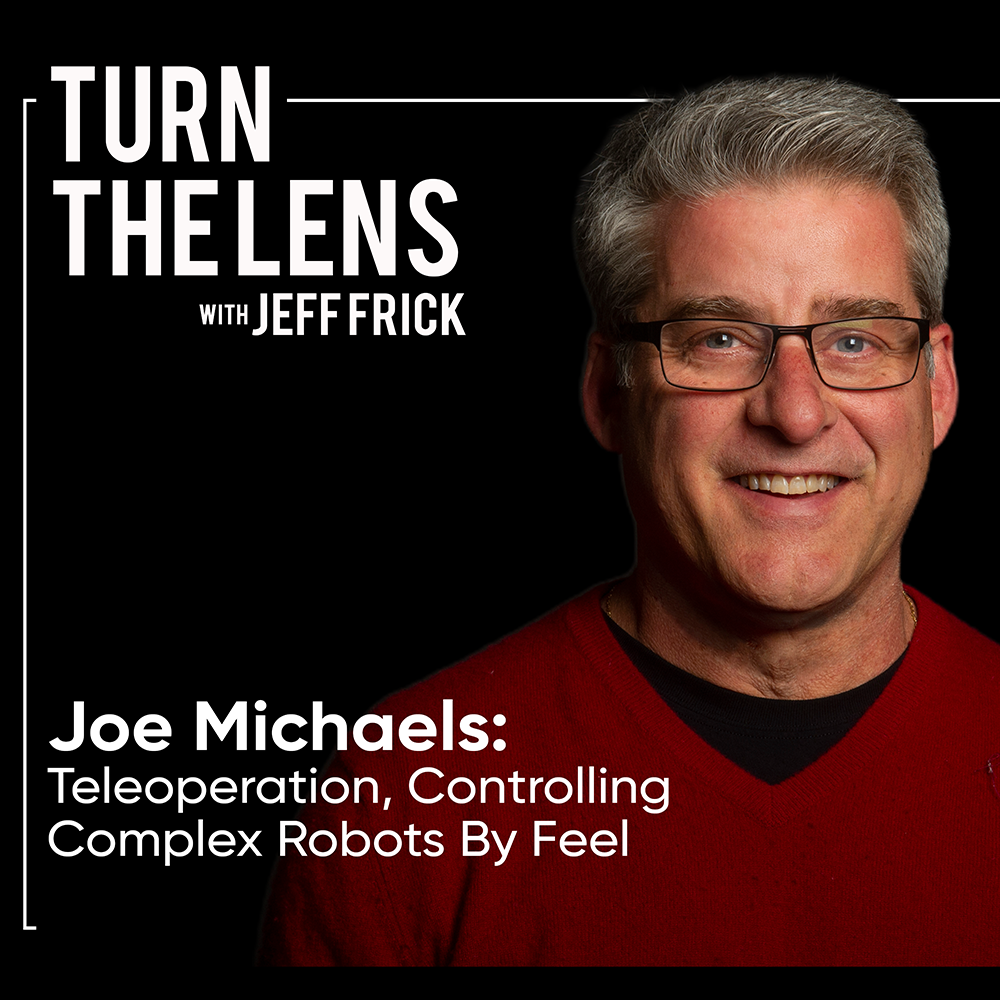
Joe Michaels: Teleoperation, Controlling Complex Robots By Feel | Turn the Lens with Jeff Frick Ep52
English Transcript
© Copyright 2026 Menlo Creek Media, LLC, All Rights Reserved
Interview Intro
Jeff Frick:
Hey welcome back everybody. Jeff Frick here. Coming to you from the Baylands. It's bright. Usually I have my sunglasses on if I'm in sun this bright. And there's no drone flying out here. We're way too close to way too many airports. And it's windy, so hopefully the mic is working well. Thank you for all the feedback. I'm getting great positive feedback on the drone footage. I'm glad you're enjoying it. But in the spirit of you know, still keeping with new tools and changing it up for 2026, I just brought the regular camera out here to the Baylands to introduce the next, in a series of interviews that we did in collaboration with Humanoids Summit and ALM Ventures and Modar we are co-releasing those to the 'Turn the Lens' community on the 'Turn the Lens' network.
So I'm really excited about that opportunity. So this next interview is with Joe Michaels. He is the SVP Sales and Marketing for 1HMX. Human machine interface is what they're all about, HMX. Their history is in gloves and haptic gloves because there's this whole concept that's super important. You need feedback. You need, when you touch you need a feedback loop. So there's sensors on the machine. How does it get back to the teleoperators?
So what is teleoperation? Turns out that as much training as you do with the robots. A lot of times the final little polish is done via teleoperation. Whether that be just a hand of a person in a glove that's operating the robot, or whether it be a full body suit that looks like something out of a fun video game, or a virtual reality space. And that's the stuff that Joe's company puts together so that companies can do the final little pieces of the training. So it's connecting the sensors you know, on the attenuator [end effector] on the hands or the grippers or whatever it is back to a human operator so they can fine tune all the little pieces of the puzzle. So I'm excited to release this next video. He's Joe Michaels. Thanks for watching. Thanks for listening. See you next time. Take care. Bye bye.
INTERVIEW
Cold Open
Alrighty.
Alright.
So in 5, 4, 3...
INTERVIEW
Jeff Frick:
Hey welcome back everybody. Jeff Frick here coming to you from the Computer History Museum in Mountain View, California. We were here a year ago for the inaugural Humanoids Summit. They brought it back again this year. There was one in London last summer [May 2025] and they just announced Tokyo for next summer [May 2026]. So things are really moving fast in this space. For a whole combination of reasons. One of the big ones is training.
And we're really excited to have our next guest who's very, very close to the training space. He's Joe Michaels, the SVP, Sales and Marketing from 1HMX. Did I get it right, Joe?
Joe Michaels:
You got it just right. Which is you passed your first test.
Jeff Frick:
Excellent. So tell us, give us the 101 on 1HMX.
Joe Michaels:
Yeah. 1HMX is the human machine experience company.
Jeff Frick:
Now we get the HMX.
Joe Michaels:
The HMX works now.
Jeff Frick:
Okay, alright now I got it
Joe Michaels:
It's all about interfacing between the human and whatever the machine is. So we make everything from touch panels to buttons all the way up through the most exciting kind of interfaces with robotics.
Jeff Frick:
Right. So I can't help but think of the which movie was it when they're in like the big exoskeleton fighting with the alien.
Joe Michaels:
Oh, yeah. That was Aliens, right? With Sigourney Weaver.
Jeff Frick:
Right, right. Is that the most famous human robot interaction?
Joe Michaels:
That was the most famous human monster interface in history.
Jeff Frick:
But they're in that exoskeleton, right. So what is human machine interface? Why do we need to interface directly?
Joe Michaels:
Well, since the first machine there's been a challenge to basically understand what the human intends for the machine to do. And, you know, they're simple grips and they've given way to buttons and that's given way to voice interface. And touchless panels. And now, you know, we have even more complicated machines that are very human like and need to understand. If I'm a humanoid robot what are you, the human pilot, want me to do? And how do I do an increasing number of really difficult tasks. Right. So how do I get work done as a humanoid robot? And so having the right haptic gloves having the right full body control system is really important to get the humanoid to do what you need it to do.
Jeff Frick:
And not only to do what you need it to do, but more importantly probably to train it what you want it to do tomorrow. Right, there's the big theme has been in the humanoids, especially comparing to like large language models. There's just not enough data. There's not an internet full of data of robot actions. There's not the same kind of visual libraries that there was for visual. And so a lot of talk here about the training. Synthetic data plays a big piece. Watching video plays a big piece. But at the end to fine tune it it comes back to teleoperation. And that's where you guys play to get that real fine grain step to make the thing really, actually work.
Joe Michaels:
That is exactly right. I think there's a dream out there of just showing enough video to the robots to build a big enough VLA models so that the robots can just go out on their own and do everything. But the big problem is that's really not how humans or robots learn how to do complicated things.
Jeff Frick:
Right.
Joe Michaels:
Right. You can understand through those models the intelligence of learning your environment understanding where I am and what I'm supposed to go do and even you can control two finger grippers that way. But today's humanoids you know are getting dexterous you know, 20 degree of freedom robot hands with five digits. And you're not going to control that with video. You need to teach that how to behave and how to work. And so, you know, our gloves our HaptX gloves we put these on the human operator and the human operator now has 135 points of feedback on the fingertips and the palm of the hand and they can feel exactly in real time. What that robot hand is feeling and control it very effectively. And it's generating a ton of data lots more than just that tactile feedback to really go into these models. And teach them how successful and unsuccessful work is happening.
Jeff Frick:
Is there a mirror glove on the robot that's got like a 1 to 1 relationship from places on the hand? Or how does. How does that work? Because I. It sounds like most of the robots don't have 130 touch sensitive sensors at this stage of the game.
Joe Michaels:
Yeah, it's not exactly a mirror glove although I like that concept. But it's sensors. It's a growing number of sensor options that can be affixed to the fingertips on the palm of the robot hand. And when they make contact depending on how sensitive they are you can map that contact back to the gloves. Exactly. So there's no lag, no latency. And you just you can just feel what the robot is feeling and do work beyond just gripping a bin and moving it. Now you can pick up tools and you can pick up parts and pieces and work with them. And this is the kind of work that that will really expand the capabilities of robots in the labor force. They're not just moving stuff around they're really supplementing human labor, doing the kinds of difficult, dirty, dangerous jobs that we don't want to do.
Jeff Frick:
Right, right. So you've been in the space since 2016 when you joined HaptX.
Joe Michaels:
Yeah.
Jeff Frick:
So you've been in that in the touch and the feeling and the physical feedback space for a long time. Why is physical feedback so important in touch. And I don't know that people are really attuned to how much of that feedback loop goes back into the way that we operate. And then secondly how has the world changed ten years ago is a long time ago in this space so give us a little bit of a longitudinal perspective as to where we are now compared to where we were when you started.
Joe Michaels:
Absolutely. You know, I'll start by saying some of the things that have changed over the last call it ten years is the world has caught up to our passion for robots. I mean, it's just so exciting to be at a place like Humanoids Summit where it's packed with people who care about you know, physical AI and and behavior models and actuators and not just joints. And this is the kind of stuff we love. So it's really cool how much attention the world is paying to robots. And the part that, you know, to your first question, the part that we've been focused like crazy on is touch is how does that help? When you try to get a robot to or anyone to do a task and take away their sense of touch like I love to show a Swedish experiment where they injected anesthetic into a subject's hand and said now pick up a match and light it. And the poor woman had no capability of doing it. The matches were falling everywhere. When you remove someone's sense of touch their capabilities drop off tremendously and so bringing that back into the robot equation and giving the human the feeling of what that robot is doing and creating a closed loop. So the robot benefits from the human motion and the the human benefits from data coming off the robot. It just makes a very natural and powerful control system that I think is going to take us into you know, the future of dexterity.
Jeff Frick:
Tell us a little bit about how the ecosystem is evolving because you know, we're hearing about all these foundational models that are trying to do really general purpose things. And people want to license them. It sounds like there's still a little bit of the open source research papers that were everything was open maybe it's not quite as open as much, but there seems to be a lot of partnership. You know, people are OEM'ing components like hands. Maybe I don't want to work on hands but I can get at somebody else's hands. How's the ecosystem kind of gelling? You know, you were at Microsoft for a long time. Huge ecosystem, great go to market kind of things around the company that really helped make that successful. How is it evolving?
Joe Michaels:
Well, one of the things that we did at Microsoft that and others in the industry the giants in the industry really worked hard on was standards, creating platforms, creating languages and protocols that made it easy for you to take any one part and plug or a piece of software and plug it into something else and it just works. And that's sorely lacking in today's immature you know, humanoid industry. We'll get there. There's just such a sudden rush of interest. We don't quite have that. And so that's one thing we really need.
And for example a lot of my customers come to me and say, hey, I don't just want your gloves I want a whole teleoperation rig. I want robot hands I want sensors at the end of those hands. I want the networking capability and the stereoscopic vision, you know to help the human operator see what the robot sees. And I need you know machine learning and it's it's just a lot of different parts and pieces today. And we're working on it. We're working on getting these. It starts with a few wins a few successful partnerships and companies like Nvidia and Google that are just putting lots of energy into industry wide standards.
Jeff Frick:
So tell us about the NX1. And you showed me a picture of it before we got on. Like this full body. It looks like you're like you're entering the alien exoskeleton thing. How long has that been out? Is it mainly used for teleoperation? Is it mainly used for training? Do you ever use it for, like, getting out of corner cases? I mean, it's a pretty interesting platform.
Joe Michaels:
It's an amazing platform that we just announced in November [2025] And Nexus NX1 is we think the first full body system for controlling a machine. So you can step into this rig and you are on an omnidirectional treadmill with motorized shoes and that combination gives you just a very natural gait that's totally safe because you're held in place and you could walk a million miles without moving more than a foot or two. And it feels like you're walking. And it feels like you're just walking. And you, you basically don the HaptX gloves and a bunch of body tracking, technology. And you are fully embodied in a humanoid robot. And that whole rig is an incredible tool for teleoperating and training bipedal robots because the world is moving toward bipedal I think we're getting there slowly, but the world is absolutely moving in that direction. And when mobility comes into the picture you don't want to just control it with an Xbox controller or even your hands. Your full body should be involved. And that's what Nexus NX1 is about.
And it also controls avatars in virtual reality so you can train people to do work. Again, you're not controlling a robot. You're controlling your own sort of body if you will in a virtual environment. And that's how you train people to do work maintenance and operation and medical professionals are training in VR. And this will really help the kinds of people who need to move throughout that space.
Jeff Frick:
So is it more training than than real time operation would you say? Because I was going to ask you about latency. But latency obviously is not a big deal in training per se. And it but but I would also imagine that the unit with the operators is very seldom within proximity of the of the robot that they're operating or is that not.
Joe Michaels:
You know, it varies. It really varies and to be clear latency is a big deal. Lag and latency are a big deal because when, especially when you're controlling a robot you can't have you know you can't see something before you feel it or feel something before you see it. It has to be synced up like how uncomfortable it is on a zoom or a teams call when you know the audio doesn't match the mouth. And imagine that on the scale of whole body trying to do work. So latency is important. And you know, we know how to do it. And if you get the right networking you know, it's not a big deal. And where it comes into play especially is when you're networking lots of people together which can happen with our products. You can network people together into a multiplayer universe in you know, in virtual reality you can network multiple robot operators together. And it's really exciting. But you got to watch out for, you know, for the latency.
Jeff Frick:
Yeah. As you're saying that I'm just thinking you know, your limitations based on the way that we're set up and designed is completely out the door with what you could do with a robot. So again, you said potentially multiple operators on the same machine, multiple machines with the same operators. It doesn't have to be kind of this one-on-one relationship at all, does it?
Joe Michaels:
Teleoperation is going in a lot of different directions and it's very powerful. And I read a lot of criticism of teleoperation on social media.
Jeff Frick:
They're digging on 1X, right, right now?
Joe Michaels:
It's really harsh. And to be fair if any robot maker is trying to use teleop behind the scenes to kind of fake autonomy it's fair criticism, but let's call it what it is. Teleop is a powerful tool that is going to be used to do things like put a human intelligence, human dexterity, human decision making into a remote environment, live you know, through operating a worker robot it'll be used for training AI like we've talked about. And one interesting thing people aren't really thinking about is temporary teleop rescuing robots when you're in a Waymo and you hit a dead end and the car can't figure out where to go a human kind of patches in solves the problem and Jack's back out. And the same thing's going to happen with humanoid robots through teleoperation. It's a very valuable tool.
Jeff Frick:
Yeah. It's interesting. We interviewed a company years ago that was doing that for autonomous vehicles and their use case was to get cars out of corner cases but not just call back to home but actually throw the operation back to the warehouse. And these guys were doing it with Logitechs and Fords. It was amazing. Unfortunately, they were way too early. The market wasn't ready and they're out of business. But this idea of of throwing back to a remote operator to get out of corner cases I think is really interesting. So what are some of the next big challenges that you're looking forward to to either taking down or will be taken down pretty soon that's going to move us a step function?
Joe Michaels:
Yeah, I mean we're, we just announced Nexus NX1 so.
Jeff Frick:
Shipping hardware.
Joe Michaels:
Shipping hardware is our first big challenge. And we're going to ship it in Q2 of 2026 God willing.
Jeff Frick:
Any price you can share or.
Joe Michaels:
No we're not sharing. That's okay, Thanks. We're not sharing the price publicly but we're you know, we're sort of discounting the HaptX gloves component of it to to make it a very attractive price. And people are responding really, really well. We do share the price in private business conversations but just, you know shipping that hardware and then you know ensuring that it works with more and more kinds of hardware that back to that standards you know, idea, it's vital. So no matter what robot hand you know, you're using, no matter what sensors no matter what or whose robot you're using we can be there powering it and making it work for you. That's a big big challenge that we're ready to go tackle.
Jeff Frick:
Do you think the the world is ready to buy the robot or do you think 'robot-as-a-service' for [RaaS] some period of time is going to be the way just because there aren't that many specialized, you know, people to repair the machines and this, that and the other, it seems like the service method in the short term is a is an easier way to go.
Joe Michaels:
It's certainly a lower risk way for the end customer. It's a very expensive way to go for the hardware makers who have to, you know, build out all this stuff before you know they see their revenue. And, yeah, I think I think at first it'll be a wonderful kind of low barrier to entry approach. But I think over time the math just settles out. And you know what it, what the value is of the hardware. And you'd rather buy it, own it, you know, kind of take it off your your books as some kind of expense. You've got to keep paying. And I think it'll be, you know, it'll, it'll probably tend less to the RaaS model and move to you know to sort of ownership. CapEx.
Jeff Frick:
Okay. And then just again you're in the business side when you think about business impediments like insurance and these kind of no fun things that we have to deal with. But to actually get a sale. you know, they have to be secure and safe and someone's got to insure them. And those kind of not necessarily regulatory, but 'governance-y' kind of barriers. Are those coming down? Are they still a big impediment. Is the industry catching up? What's kind of your take there?
Joe Michaels:
We are just beginning to figure out what these things can do what the dangers are and how to regulate it all. And safety is a massive issue. Many of the humanoid robot deployments that I'm aware of have, you know proceeded slowly and carefully a lot slower than we'd all like because you're talking about introducing very large, very powerful you know, high force machines into the same environment with humans. You can't take risks on that. So, you know, I think there are safety regulations. I don't know so much about insurance but I think, you know just getting building that trust that the robot will do what it's what you think it's going to do and do it safely. And when it fails, it doesn't fail dangerously. It fails safely. All of that is paramount. And we're taking the first step in a marathon.
Jeff Frick:
Right. Well, good luck shipping that machine if you need someone to come test it out you know, I'm happy to come over and see if I can run 100 miles without moving.
Joe Michaels:
Without moving ten feet. You're in, man. You're in. You'll be one of our first testers.
Jeff Frick: All right, Joe. Well, congratulations. Exciting space. And, ten years is really moving and moving and continues to go steeper. Right.
Joe Michaels:
That's from your lips to God's ears. Thank you.
Jeff Frick:
All right. He's Joe, I'm Jeff. You're watching Humanoids Summit from the Computer History Museum here in Mountain View, California. Thanks for watching. Catch you next time. Bye bye.
COLD CLOSE:
Alright,
Your clear
Blah, blah, blah, blah, blah, blah
we'll cut that one out
Joe Michaels: Teleoperation, Controlling Complex Robots By Feel | Turn the Lens with Jeff Frick Ep52
English Transcript
© Copyright 2026 Menlo Creek Media, LLC, All Rights Reserved