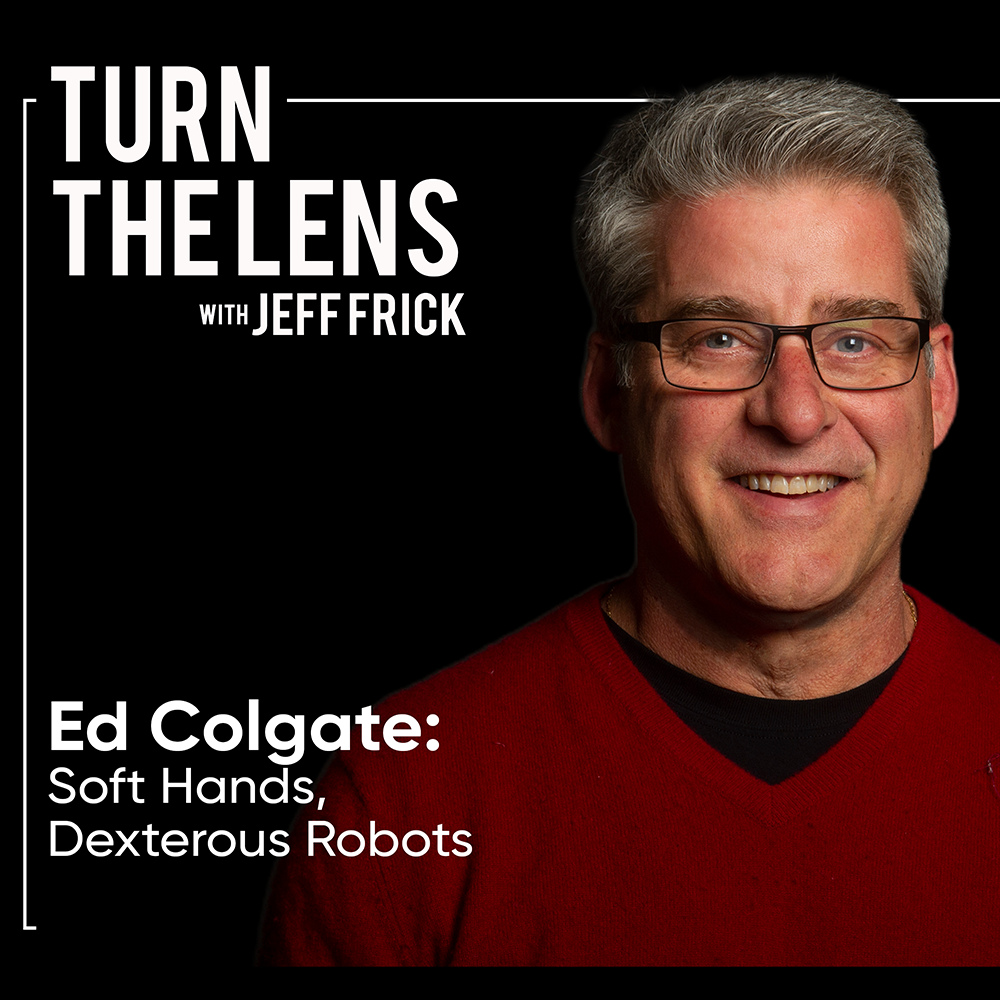
Ed Colgate: Soft Hands, Dexterous Robots | Turn the Lens Ep48
"I tend to think of dexterity as being this sort of beautiful kind of negotiation between us and the world." - Ed Colgate
Or listen on:


Ed Colgate and his team are tackling one of robotics' hardest problems: the hand. Ed directs the HAND ERC (Human AugmentatioN via Dexterity Engineering Research Center), a major NSF-funded initiative bringing together Northwestern, MIT, Carnegie Mellon, Florida A&M, and Texas A&M, with a decade-long mission to develop dexterous robots that help people be more productive in their work.
The research spans three critical areas: advanced hardware (artificial muscles that respond to thermal, light, and electrical stimulation), AI control systems (finally making complex dexterous manipulation possible), and human-robot interfaces (bridging the brain-machine bandwidth gap for prosthetics and assistive robotics).
I sat down with Ed to explore why softness matters more than precision, how AI changes everything about robotic hand control, and why robots keep overheating at the Humanoids Summit 2025, hosted and organized by ALM Ventures at the Computer History Museum in Mountain View, California.
Ed walks through the contact mechanics revelation, the challenge of engineering durable soft materials, the actuation density problem (30-35 muscles packed into a tiny space), and how AI enables prosthetic hands to provide sophisticated control from limited brain signals. He also shares why motion smoothness dramatically affects human acceptance of robots—a subtle detail with massive implications.
Large contact areas, slipping and sliding, environmental negotiation, artificial muscles, brain-machine interfaces—top concepts covered. But what struck me most was his perspective on dexterity itself: not as precise control, but as a dance between intention and adaptation, between what we want and what the world allows.
That is a robot future built on understanding rather than forcing.
Please join me in welcoming Ed Colgate to Turn the Lens, in collaboration with Humanoids Summit and ALM Ventures.
This interview is a collaboration between Turn the Lens and Humanoids Summit, and was conducted at the Humanoids Summit SV, Computer History Museum, Mountain View, California, December 12, 2025. Humanoids Summit is organized and hosted by ALM Ventures.
Learn more about Humanoids Summit at humanoidssummit.com
Ed Colgate: Soft Hands, Dexterous Robots | Turn the Lens with Jeff Frick, Ep48
Guest Information
Ed Colgate, PhD
Current Position:
Contact & Links:
Research Areas:
Overview:
Official Links:
Lead Institution:
Partner Institutions:
MIT (Massachusetts Institute of Technology)
Carnegie Mellon University
Florida A&M University
Texas A&M University
Three Core Research Thrusts:
1. Advanced Hardware Development
2. AI Control Systems
3. Human-Robot Interfaces
Dexterity & Manipulation
Dexterity - The ability to skillfully manipulate objects, particularly in-hand manipulation (reorienting objects without releasing them)
In-Hand Manipulation - Reorienting or adjusting objects within the hand using finger movements; humans excel at this (e.g., flipping a pen, rotating a screwdriver) while robots struggle
Contact Mechanics - The study of how contact area, pressure distribution, and surface properties affect manipulation success. Humans use large soft contact areas; robots typically use small rigid point contacts
Grasp Stability - The ability to maintain secure hold on an object despite perturbations; enhanced by large contact areas and soft surfaces
Environmental Negotiation - Ed Colgate's concept: "beautiful kind of negotiation between us and the world" - dexterity involves adapting to object shapes, using gravity, allowing slipping and sliding within controlled parameters
Soft Robotics - Branch of robotics using compliant, deformable materials to enable safer interaction and adaptability
Compliant Mechanisms - Mechanical systems that achieve motion through elastic deformation rather than traditional joints
Soft Tissue Engineering - Development of durable soft materials with embedded sensing for robotic skin applications
Contact Area Maximization - Design principle: larger soft contact areas provide better sensing, stability, and manipulation success
Tactile Sensing Arrays - Dense networks of sensors embedded in soft robot skin to provide detailed physical feedback (mimicking human skin mechanoreceptors)
Artificial Muscles - Advanced materials that contract/expand like biological muscles in response to stimuli:
Actuation Density - Challenge of packing sufficient motor power in limited volume (human hand: 30-35 muscles in forearm/hand space)
Heat Dissipation Challenge - Common problem where robotic hands overheat due to motor density and continuous operation
Muscle Redundancy - Biological strategy where multiple muscles control single joints; provides fine control and robustness
Brain-Machine Interface (BMI) - Technology connecting neural signals to external devices (prosthetics, computers, robots)
Neural Bandwidth Limitation - Current BMIs cannot connect enough signals to control highly dexterous prosthetic hands with many degrees of freedom
Autonomous Intelligence Solution - Using AI to enable prosthetic hands to execute complex tasks from limited high-level neural commands
Shared Autonomy - Control paradigm where human provides intent and AI handles low-level execution
Motor Impairment Applications - Assistive robotics for individuals with limited mobility, whether from limb loss, paralysis, or degenerative conditions
Model-Based Control - Traditional approach using mathematical models of robot dynamics; struggles with complexity of dexterous hands
Learning-Based Control - AI/ML approaches that learn manipulation strategies from experience/demonstration
Sensory-Motor Feedback Loops - Continuous cycle of sensing contact/forces and adjusting motor commands; critical for dexterous manipulation
Contact-Rich Manipulation - Tasks involving continuous physical interaction with objects and environment; particularly challenging for robots
Simulation-to-Reality Transfer - Training AI in simulation then deploying to physical robots; active research area
1. The 40-Year Challenge
2. Contact Area Revelation
3. Beyond Collision Safety
4. Slipping, Sliding, and Environmental Dance
5. Engineering Durable Softness
6. Artificial Muscles Solve Density Problem
7. AI Bridges the Prosthetic Gap
8. Motion Quality Affects Acceptance
Early Pioneers (1960s-1980s)
Modern Era (1990s-2010s)
AI-Enabled Era (2020s)
Haptics & Force Feedback
Grasp Planning & Optimization
Soft Robotics
Reinforcement Learning for Manipulation
Prosthetics Research
Recording Information:
Context:
Interview Style:
[Note: Add specific papers from Ed Colgate and HAND ERC team as they become available]
On What's New: "The big thing that's new now, of course is AI. The ability to take something so complicated as this hand and actually do something useful with it. That wouldn't be possible without AI."
On Previous Limitations: "When people have built hands, it looks like a hand, but they really wouldn't do very much."
On Contact Area Difference: "When humans use their hands they usually establish really large areas of contact. When robots do, not the case. Really different, really dramatically different."
On Why Contact Matters: "Probably those large contacts really help solve the problem of dexterity. The skin has got all sorts of sensors in it that tell their brain what's going on in a really, you know, minute, intimate, physical way."
On Softness Benefits: "That softness also just kind of keeps everything stable in your hand. It makes it easy to hold things, makes it easy to succeed."
On Beyond Safety: "It's not just the safety—it's softness itself. It's the sensing. It's, you know, all the, it's what that surface can do, right?"
On Dexterity as Negotiation: "I tend to think of dexterity as being this sort of beautiful kind of negotiation between us and the world."
On Finger Compliance: "Our fingers, our human fingers are sort of very easy to push back on. And they're very soft and so we can do these things which a lot of robots have trouble with."
On In-Hand Manipulation: "We've developed this ability to be incredibly facile at these sorts of in-hand manipulations. And that's probably not an accident. Right, so it's probably something we need to think hard about for robots."
On Brain-Machine Interface Challenge: "You can build a prosthetic hand that may have all the motions of a human hand, but you can't connect that many signals back to the human brain with existing technology."
On AI Solution for Prosthetics: "One of the really interesting opportunities is to use a smaller number of signals from the human brain. But to still control a really complex system, because it now has a lot of its own capability and intelligence."
On Actuation Density: "We have something like 30, 35 muscles that control a human hand. And everything is packed in a really small space in your forearm, in your hand. That makes it really tough to engineer with today's tools."
On Motion Quality: "The smoothness of the motion conveys so much information in terms of a human's acceptance of this machine. It's really a super important piece of it."
On Project Enthusiasm: "They're all cool in my view. I love all my kids." (regarding HAND ERC projects)
Actuator - A mechanical device that produces motion; motors, pneumatic cylinders, artificial muscles
Biomimetic - Mimicking biological systems; designing robots inspired by nature
Compliance - The inverse of stiffness; how easily something deforms under force
Contact Point - Where robot finger/gripper touches an object
Degrees of Freedom (DOF) - Independent ways a system can move; human hand has ~27 DOF
Dexterous Workspace - The region where a hand can manipulate objects
Electroactive Polymer - Material that changes shape with electrical stimulation
End Effector - The device at the end of a robotic arm (gripper, hand, tool)
Force Closure - Grasp that can resist forces in all directions
Haptic - Relating to sense of touch; haptic feedback provides force/texture information
Kinematics - Study of motion without considering forces
Mechanoreceptor - Biological sensor that responds to mechanical pressure or distortion
Myoelectric - Relating to electrical signals from muscles; used for prosthetic control
Prehensile - Capable of grasping; prehensile hands can grip objects
Proprioception - Sense of body position and movement
Sensorimotor - Involving both sensory and motor functions
Shape Memory Alloy - Metal that returns to original shape when heated
Tendon-Driven - Actuation using cables like biological tendons
---
Ed Colgate: Soft Hands, Dexterous Robots | Turn the Lens with Jeff Frick, Ep48
© Copyright 2026 Menlo Creek Media, LLC, All Rights Reserved
Ed Colgate: Soft Hands, Dexterous Robots | Turn the Lens with Jeff Frick, Ep48
English Transcript
© Copyright 2026 Menlo Creek Media, LLC, All Rights Reserved
Intro Open
Jeff Frick:
Hey welcome back everybody. Jeff Frick here. Coming to you from the San Francisco Baylands, not too far actually from the Computer History Museum in Mountain View, California, where last December I had ten amazing interviews at the Humanoids Summit. And I'm so excited that in collaboration with Humanoids Summit and ALM Ventures, we are co-releasing those interviews via Turn The Lens.
So I'm excited to release the next interview in that series is Ed Colgate. He's a professor at Northwestern University, but in this context he's running something called the HAND ERC. And I have to read it because it's not an easy thing to remember. It is the Human AugmentatioN via Dexterity, HAND, Engineering Research Center.
So it's a government funded program that's got five universities, I think 33 faculties, a lot of students doing core research around hands, around dexterity. What does dexterity actually mean? The difference between robotics and prosthetics and a few other interesting topics along the way.
So without further ado, my interview with Ed Colgate from the HAND ERC and Northwestern University. Thanks for watching. See you next time. Take care. Bye bye.
Main Interview
Cold Open
Take a picture for the thumbnail.
OK.
And then, we’ll take one with the both of you.
Ready, 1, 2, 3.
Jeff Frick:
Hey welcome back everybody. Jeff Frick here. Coming to you from the Computer History Museum in Mountain View, California. It's our second year here at Humanoids Summit. They were here a year ago, and they just announced they're taking the show to Tokyo next year. So it's exciting times in the Humanoids Summit and in humanoids.
And even a year ago, we said they were having a Cambrian moment. But what happens in 24 months or 12 months? Quite a bit. So we're excited to have somebody who's working on one of the hardest problems. And as we know what that is, is the hand.
So welcoming in, he's Ed Colgate. He’s a professor at Northwestern. But more importantly, he is now running—let me make sure I get my notes right here—the Director of the HAND ERC, Human AugmentatioN via Dexterity Engineering Research Center. It's a mouthful. It's a mouthful, you announced it yesterday, but it's a big investment with a lot of academic institutions, professors and PhDs. So tell us a little bit about the project.
Ed Colgate:
Yeah, sure. Okay, so an ERC is an Engineering Research Center. It's funded by the National Science Foundation here in the US. Ours is, as you said, it's called Human AugmentatioN via Dexterity, HAND.
So we are trying to develop dexterous robots that can help people be more productive in their work. This is a pretty big effort. We’ve got five core universities working together. I'm at Northwestern. We're kind of the lead institution, but our partners include MIT, Carnegie Mellon, Florida A&M, and Texas A&M, and maybe 33 faculty and a whole slew of students working on all sorts of problems.
How do you develop advanced hands? How do you develop the AI control for them, and how you develop the interfaces so that people can actually put them to use?
Jeff Frick:
And is that a new initiative, relatively new?
Ed Colgate:
It's relatively new. So these grants are basically a five year, extendable once. So usually these centers last for a decade.
Jeff Frick:
Okay.
Ed Colgate:
We started about a year ago.
Jeff Frick:
Okay, great. But you've been working on the hand problem for a lot longer than that. In fact, getting ready for this, I saw you going through a book of the grandfather of the hands that you were so excited to get. So what's new as you look at kind of longitudinally the challenge of the hand, where we are now compared to where we used to be and where we're going to be tomorrow?
Ed Colgate:
Yeah. That's great. Well, there’s a lot of challenges ahead. I mean people have been working on robotic hands, gosh, for probably 40, 50 years now. If you look into the history of it, you know, really as long as we've been thinking about robots, we've been thinking about the hand.
And what's new? I mean, the big thing that’s new now, of course, is AI. The ability to take something so complicated as this hand and actually do something useful with it. That wouldn't be possible without AI. So in the past when people have built hands, you know, it looks like a hand, but they really wouldn't do very much.
Now we have that hope, but it's also sort of pointing out that there's a lot of things about the way this thing is designed and built that we need to learn from. So, for instance, one of the things that we’ve noted is that when humans use their hands, they usually establish really large areas of contact. When robots do, not the case. I mean, really different, really dramatically different.
Now, why is that? All right, well probably those large contacts really help solve the problem of dexterity. The skin has got all sorts of sensors in it that tell their brain what's going on in a really, you know, minute, intimate, physical way. That softness also just kind of keeps everything stable in your hand. It makes it easy to hold things, makes it easy to succeed. So that's one example, and lots of other things.
Jeff Frick:
Right. So you had a great talk yesterday and you talked about the softness. So let's dive into the softness for a little bit. And I learned last year about collisions, which normally people call bumping into things.
Ed Colgate:
Yeah.
Jeff Frick:
And it's a real problem if a big heavy machine bumps into grandma and knocks her over. So we have this soft material. But then you said it’s hard to get a soft material that will last. But what struck me is our skin doesn't last either, right?
Ed Colgate:
That’s right.
Jeff Frick:
It's cut and it gets regenerated.
Ed Colgate:
Yep.
Jeff Frick:
And then the other piece that you talked about, which is so unique, is the sensors.
Ed Colgate:
Yep.
Jeff Frick:
And having sensors not just a couple but a lot. And you made a really funny comment. You talked about most people are doing pressure sensors and we don’t have pressure sensors in our hand.
Ed Colgate:
Yeah. Yeah.
Jeff Frick:
So this whole thing is going through my head and it seems like it's like there's this, there's the hands, but it sounds like a really important piece is the skin.
Ed Colgate:
Yeah.
Jeff Frick:
Should the skin be a separate effort? Because all of the skin stretches far beyond our hands as well, right, to get that sensor kind of array? So where does—the soft tissue thing was really fascinating comment to me. Because that's a real hard challenge to be both durable but also pliable and then all the goodness that comes from the softness for control.
Ed Colgate:
Yep, yep, exactly. So yeah, kind of the way we look at it is when you look at actually solving the problem of dexterity, it really helps to have those big contacts I was talking about. Well how do you get them? Softness. If you have to. If you really need softness to be dexterous, then we've got a whole slew of problems because things that are soft are usually not durable. So let's talk about the skin. You're right. Human skin, it's not all that durable. We're constantly rubbing it off, right. But it is, it’s an amazing thing of regenerating itself from the inside out.
We don't have that technology and quite frankly we're not even trying to develop that. You know, it's not clear that we want to solve all our problems the same way a biological system does.
Jeff Frick:
Right, right.
Ed Colgate:
But we still have to solve the problems. If we want things that are soft, we have to figure out how to make them durable. Right? We have a lot of other methods that we can use. We can work with materials that maybe biology can't work with. We can work with metals and ceramics and things like that, which are of course not soft materials. But then we can put them together in a matrix with things that are soft.
We can use geometry and make them bend and—so there's a lot of interesting tools at our disposal as engineers that biology may not have had access to. So yeah, we are working actively on that problem. We have a team at Texas A&M and Florida A&M that's very actively trying to figure out how do we make skin and how do we make it durable? And then at Carnegie Mellon they're asking a question of, well how do we integrate that with sensing so that we know what's happening to the skin?
Jeff Frick:
Right. You had another really great demo to demonstrate what is dexterity?
Ed Colgate:
Yeah.
Jeff Frick:
You just had a little toy, I think it was a little plastic hand.
Ed Colgate:
Yeah.
Jeff Frick:
Oh do you have it?
Ed Colgate:
No, I got something similar though.
Jeff Frick:
Yeah, pull it out and just—
Ed Colgate:
Yeah.
Jeff Frick:
Just gently manipulating in that and—
Ed Colgate:
Right.
Jeff Frick:
And calling out the fact that you can see any part of that object—
Ed Colgate:
That's right.
Jeff Frick:
Pretty easily. And the part that really jumped out to me that you think of specifics and details, but you're talking about slipping and sliding.
Ed Colgate:
Yep.
Jeff Frick:
And all of these ways—
Ed Colgate:
Yeah.
Jeff Frick:
We're using gravity and not really manipulating it but letting the environment, the environment manipulate it within our kind of controlled subset.
Ed Colgate:
You know, I'm glad you noted that because I tend to think of dexterity as being this sort of beautiful kind of negotiation between us and the world. Right? I mean, the world says here's the shape of this thing. My fingers are going to adapt to that. But I let them do that. And so our fingers, our human fingers, are sort of very easy to push back on. And they're very soft and so we can do these things which a lot of robots have trouble with.
But yeah, what I was pointing out too is that I can give you any object that's roughly this size. I don't care what it is. And, you know, you absolutely know you can go and inspect every side of it, right? So what the point is, we’re really good at this, right? We've developed this ability to be incredibly, you know, facile at these sorts of in-hand manipulations. And that's probably not an accident.
Jeff Frick:
Right.
Ed Colgate:
Right, so it's probably something we need to think hard about for our robots.
Jeff Frick:
I want to get your take on another angle. And this is kind of the same, but different, which is robotics, prosthetics—
Ed Colgate:
Yeah.
Jeff Frick:
And not enough people use the word bionics. I don't know, I guess—
Ed Colgate:
Yeah.
Jeff Frick:
They weren’t around when Steve Austin was running around.
Ed Colgate:
When Steve Austin was around, I was.
Jeff Frick:
We were. Yeah. So how do you think about the interplay between robotics and prosthetics, especially around something like a hand?
Ed Colgate:
Yeah, that's a really interesting question. So the big challenge in prosthetics—an area that I have worked on through the years—is the brain machine interface.
Jeff Frick:
Right.
Ed Colgate:
You can build a prosthetic hand that may have all the motions of a human hand, but you can't connect that many signals back to the human brain with existing technology.
So fast forward to today where we now have tools like AI. One of the really interesting opportunities is to use a smaller number of signals from the human brain, but to still control a really complex system, because it now has a lot of its own capability and intelligence, right?
So we actually have a project within our center which is focused on that for individuals who have motor impairment—maybe not missing a limb, or maybe simply having limited mobility—and they need a robot aide.
So the question is again, with very limited information bandwidth, how do you get that to be useful and do what you want it to do?
Jeff Frick:
Right, right. Yeah. Interesting.
Running out of time. I know you have a short window. Amongst all those projects—five universities, 100 professors or 24 or whatever the number, a lot of people—what are some of the cool ones that maybe are less obvious, less kind of under the radar, that are going to have a significant impact, but kind of like bumping and soft tissue maybe is not at the front of everybody's mind?
Ed Colgate:
Yeah, well I think we—they're all cool in my view. I love all my kids.
Jeff Frick:
Right. Good, good. Won’t make you pick one.
Ed Colgate:
I'll pick one.
Jeff Frick:
You can pick a couple.
Ed Colgate:
You can pick a couple. Actually I think some of the stuff we're doing in actuation is—like artificial muscle—is really interesting.
So another thing about hands, right, is that we have something like 30, 35 muscles that control a human hand. And everything is packed in a really small space in your forearm, in your hand. So it's very unlike an arm or legs or torso. You know, a lot of stuff going on in a small volume.
And that makes it really tough to engineer with today's tools. You hear lots of stories, you read lots of stories in the press about robots overheating, and it's usually the hands, right? So we need better actuators.
And so we have some really cool things going on with advanced materials that respond to thermal and light and electrical stimulation and behave like muscles do. So that's one of the ones I really love.
Jeff Frick:
Yeah. Yeah. It's really interesting how the smoothness of the motion conveys so much information in terms of a human’s acceptance of this machine. It's really a super important piece of it.
Ed Colgate:
Yeah, it absolutely is. Yeah. Yeah.
Jeff Frick:
All right Ed. Well, thanks for stopping by. Got your little jacket on.
Ed Colgate:
Yeah.
Jeff Frick:
You have all those people doing the work.
Ed Colgate:
We love our logo.
Jeff Frick:
It’s amazing times and I'm sure it'll accelerate a lot faster than it did for the last several decades.
Ed Colgate:
That's our plan. Thanks, Jeff. Appreciate it.
Jeff Frick:
All right. He’s Ed, I'm Jeff, you're watching Humanoids Summit from the Computer History Museum in Mountain View, California. Thanks for watching. We'll see you next time. Take care.
Cold Close
Great.
Clear.
Awesome.
That go ok?
Yeah, I think so.
Ed Colgate: Soft Hands, Dexterous Robots | Turn the Lens with Jeff Frick, Ep48
English Transcript
© Copyright 2026 Menlo Creek Media, LLC, All Rights Reserved

Jeff Frick has helped tens of thousands of executives share their story.


Disclaimer and Disclosure
All products, product names, companies, logos, names, brands, service names, technologies, trademarks, registered trademarks, and registered trademarks (collectively, *identifiers) are the property of their respective owners. All *identifiers used are for identification and illustrative purposes only.
Use of these *identifiers does not imply endorsement.
Other trademarks are trade names that may be used in this document to refer to either the entities claiming the marks and/or names of their products and are the property of their respective owners.
We disclaim proprietary interest in the marks and names of others.
No representation is made or warranty given as to their content.
The user assumes all risks of use.
© Copyright 2026 Menlo Creek Media, LLC, All Rights Reserved